Efficiency arises in the systemIntegrated aeration technology from AERZEN for the biology of the Unterföhring wastewater treatment plant

The municipality of Unterföhring on the northeastern outskirts of Munich is an important media and insurance centre. The number of workplaces is correspondingly high. The just under 12,000 local inhabitants see an influx of up to 25,000 commuters every day. For the local wastewater treatment plant, this imbalance leads to considerable load fluctuations throughout the day. The load profile is also changing with the increasing shift of workplaces to the home office. As more employees are working from home, some of the previous wastewater volumes are missing during the day. The load fluctuations continue to increase as a result.
“The volume of wastewater has changed significantly. We have to react to this in running operations, especially in the biological treatment stage,” says Michael Schmidt- Biro, Deputy Operations Manager of the Unterföhring wastewater treatment plant, adding: “The previous design no longer met our requirements in terms of energy efficiency and adjustability. As a general overhaul of the blower technology was taking place in 2026 anyway, we took this opportunity to fundamentally optimise the entire aeration system.” The municipality relied on the system expertise of AERZEN, whose experts implemented a holistic concept. The intelligent combination of highly efficient blower and aeration technology and smart control technology enables a precise, needs-based air supply with reduced energy consumption and lower long-term operating costs.
Continuous modernisation with a focus on energy efficiency
The Unterföhring wastewater treatment plant has been in operation since summer 1981 and has been continuously modernised and upgraded to the latest state of the art. Among other things, it is equipped with a solar sludge drying plant in which the sludge from the digestion tower is dewatered from around 75% to almost 100% dry matter using solar energy. Co-digestion also increases gas production; the biogas produced is utilised in a gas turbine to generate its own energy and this reduces the amount of electricity required from the grid. The control room is also fully digitalised. “Wastewater treatment plants move between the poles of climate protection, costs and safety of supply. We consistently exploit the technical possibilities to reduce energy consumption and CO2 emissions and ensure stable operation,” emphasises Dipl.-Ing. (FH) Thomas Scholz, Head of Civil Engineering and Transport at Unterföhring, who is responsible for the technical equipment of the wastewater treatment plant. “With AERZEN, we are now taking the next step towards greater efficiency.”
Holistic optimisation of the aeration system
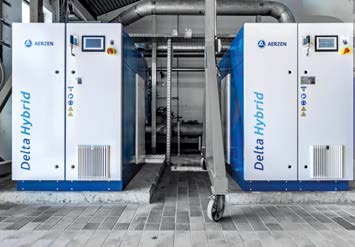
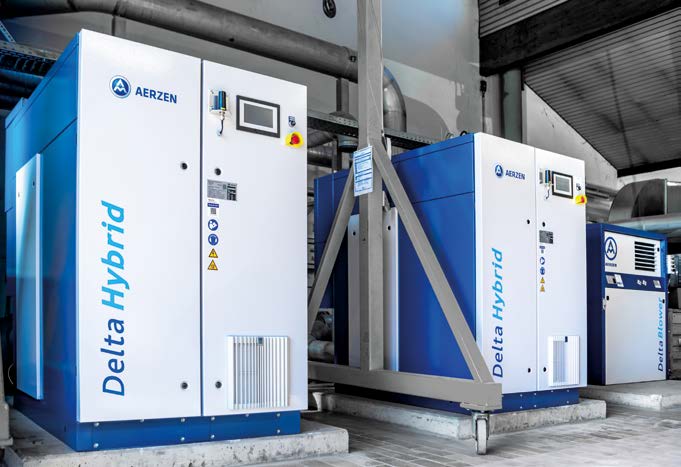
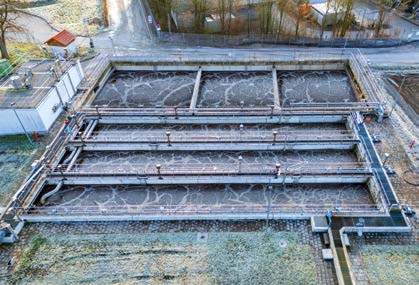
The plant is designed for 30,000 PE (population equivalents), but the current capacity utilisation is only around 13,000 PE. The annual inlet volume is around 800,000 m³. The biological treatment stage comprises two aeration tanks. The first is flowed through in three cascades connected in series, while the second is divided into three channels operated in parallel. The aeration was previously realised using AERZEN positive displacement blowers in combination with tube diffusers. A Delta Blower GM 25 S and two Delta Blower GM 50 L (volume flow range from 17.3 to 52 m³/min, drive power 75 kW) were used. The aeration system was redesigned to increase energy efficiency. Since March 2026, two AERZEN screw blowers of the type Delta Hybrid D 31 S with direct drive have been installed (volume flow range from 6 to 29 m³/min, drive power 30 kW). The blower output fell from around 52 to around 30 m³/min. The two D 31 S are taken over for regular operation, while the GM 25 S remains as a redundancy machine. Oxygen is introduced via highly efficient MESSNER aeration panels®, controlled by the MESSNER® Control system.
Integrated system technology for a new generation of wastewater treatment plants
AERZEN thinks of aeration as an integrated system. Blower, aeration and control technology are perfectly in tune with each other – “One Hand - One Solution”. “We look at the system as a whole and precisely coordinate the machine and aeration technology. The intelligent aeration control system takes care of this. This creates an integrated system with maximal efficiency,” explains Gajanthan Arumugaswamy, Application Manager Wastewater at Aerzen Deutschland, adding: “Each project is individually designed by our engineers and process technology specialists. This is based on the inflow loads and the respective process requirements. From this, we determine the oxygen requirement, from which the quantity and configuration of the aeration elements and the design of the blower technology are derived.” AERZEN works in close harmony with system manufacturers
and engineering offices.
One blower for the entire turndown range
The decisive factors in choosing the Delta Hybrid were the high turndown and the focus on energy-efficient operation. The screw blowers have a direct drive using gear wheels, an IE5 synchronous permanent magnet reluctance motor and an integrated VFD and, depending on the project, enable energy savings of up to 37% compared to conventional blowers. Both sizes convey 100% oil- and PFAS-free process and compressed air (oil-free operation according to ISO 8573-1, class 0) and offer a very large turndown ratio of 1:5. The integrated AERtronic package control monitors and regulates all relevant pressure and temperature parameters, ensuring safe, efficient and transparent operation. With a maximum sound pressure level of 73 dB(A), these machines are among the quietest in their performance class on the market.
Highly efficient aeration panels
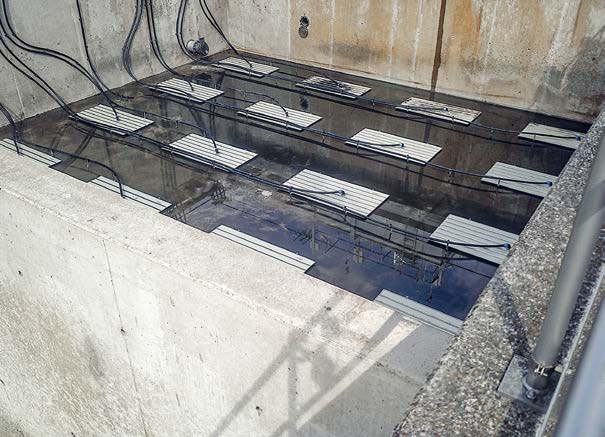
The aeration technology is also designed for energy efficiency and long-term reliability. The MESSNER®Classic aeration panels in 2 × 1 m format are made of high-quality stainless steel and fitted with a permanently elastic, low-maintenance and blockage-free membrane film made of thermoplastic polyurethane (TPU). The separate air connection line of the aerator elements ensures even air distribution, improves adjustability and increases operational reliability. This means that each aeration panel can be taken out of operation, if required, which facilitates maintenance and replacement. The aeration panels are assembled directly on the bottom of the tank. Once the service life of 15 to 20 years has been reached, they can be renewed using the replacement panel method. The stainless-steel components are retained, and only the TPU diaphragm is replaced or refitted. This enables a high level of reusability of the components and reduces material and disposal costs.
Dynamic, load-dependent regulation of the oxygen input
Control is handled by the interactive MESSNER® Control system, which was specially developed for the dynamic, load-dependent regulation of oxygen input. Intermittent and alternating aeration can be realised using sliding pressure control, pulse aeration and demand-based recirculation control. The integration of ammonium and nitrate sensors allows process-controlled adjustment of the O2 setpoint to the actual load. This ensures stable effluent values, high process stability and reduced energy demand. At the same time, N2O emissions are also minimised by avoiding over- and under-aeration.
Efficiency leap for the biological purification stage
“The new aeration system works very efficiently and can be flexibly adapted to different load ranges. This saves energy and reduces our maintenance costs,” says an enthusiastic Michael Schmidt-Biro: “The investment costs for the aeration panels are somewhat higher, but thanks to the efficient oxygen input and the long service life of around 20 years, they are more economical over their entire service life. Another advantage is the homogeneous mixing of the activated sludge during the non-aerated denitrification phases by the control system. This means we can do without agitators. The high level of adjustability of the screw blowers also enables us to reliably map both low-load and high-load phases.”
Energy savings of an estimated 40%
The bottom line is that the wastewater treatment plant in Unterföhring expects to reduce its energy consumption in the biological stage by around 40% thanks to the holistically harmonised concept, while at the same time reducing the associated CO2 emissions. The conversion was carried out at the plant during live operations. “Together with our partners, we carried out extensive work in advance so that conversion to the new aeration system could be implemented quickly and there was no downtime,” says Gajanthan Arumugaswamy.
Modern, efficient wastewater treatment
Efficient, durable, low-maintenance and quiet: with the integrated system technology from AERZEN, Unterföhring is taking biological wastewater treatment to a new level. Blower, aerator and control system form a seamless gearing unit and turn the aeration into an intelligently and load-dependent controlled overall system. The result: high energy efficiency, stable processes and a high-performance system. By the way, AERZEN blowers are not only used in the main biology, but also in the process water treatment for the treatment of the highly nitrogenous centrate from the digested sludge dewatering and in the sand trap. “We are very satisfied with the AERZEN technology. The blowers operate reliably and require little maintenance. The technology has also proven to be very robust over many years of operation,” says Michael Schmidt-Biro.
in parallel.